
This internship has kept me in Jakarta most of the time, and I’m liking that actually. It’s pretty cool to be living and working in a new place. Three months in and I can still count on one hand the number of times I’ve left the ibukota, including two out of my three visa runs. Tourists don’t really spend time here; they (or we) tend to go east to places like Bandung, Yogyakarta, Bali, Lombok. Indonesia is big and beautiful.

I like that we’ve found places to go back to, for shopping, food, working remotely and watching movies. Some of my best memories so far have been going to malls and cafes with co-workers and exploring new areas in the city. The partially remote work set-up means spending a couple hours to a full day at a cafe is not uncommon, and sometimes we plan after-work outings to the movies or dinner. One time, at midday, the power died at the office so several of us decided to work from a cafe in Senayan Park mall. We ate Japanese food there for lunch and went to the cafe, which had this sweeping view of a man-made lake. Our most routine destination has been Blok M though, it’s just a few MRT stops away and has a ton of street food, restaurants, cafes and shopping options.
The MRT route has continued to been very handy, and we’ve pretty much existed along it’s extent in South Jakarta. I go to mass at churches either near Blok M station or Bundaran HI station. Indonesia has the world’s largest Muslim population, and Southeast Asia’s second largest Christian population.

A few weeks ago, fellow CIPSie Ancella took Ana and I around Pasar Baru, which is an older area of the city (older meaning the 19th century). Ironically, Pasar Baru means “new market”. The highlights were a pork belly noodle soup from Bakmie Abun, and seeing the modernist Istiqlal Mosque and gothic-revival Jakarta Cathedral (which are across the street from each other). There was a nice public square with an interesting statue and reflecting pond. We sat around this area for a bit; a garden sale was going on nearby, so the area was bustling with people, and I saw lots of beautiful flowers and orchids.


Today, August 24th, I’m at the Universitas Indonesia (UI) library, writing this blog and doing some work for CIPS, with Ana and Adit, the head of the CIPS research team. UI is Adit’s alma mater and he likes to come here sometimes to work or relax. His kost is walking distance from ours, so we shared a taxi to the Commuter Line station and rode for about 10 mins. The campus is lush and has some man-made lakes that build up the cool (ish) breezes. Jakarta itself is very breezy, which helps any hot city, but the air at UI is much fresher. The library complex at UI is a striking sight from across the water.


It’s the normality of all these experiences for everyone else that stands out to me: I’m living a new, different life as though it’s always been my life. I like urban topics, and participating in the life of a new city is an interactive urban study: getting a sense for where people go, how they get there, and what they go there for (food, relaxation, excitement, etc.). It’s felt really cool to “join” some of the places and routines of full-on life in Jakarta.

I’ve also gotten to know some of the stresses of full-on life as a short-term expat on a tourist visa. Here’s one of those character building experiences (they actually do help with stress management skills): I got pretty panicked about overstaying my visa when it looked like I hadn’t allotted enough days for visits to the immigration office. Sara, one of the CIPS HR people, suggested I visit immigration ASAP, because I still had a few days. I was seriously, and somewhat stubbornly, considering leaving the country that weekend rather than trying my luck extending it with only a few days left. Thankfully it only took one immigration visit to extend my visa; I just had to pick it up the next day. Lesson learned: read Sierra’s visa extension guide more thoroughly (Sierra was one of the interns last year) and extend visas a week before they expire.
On a happier note, we’ve been spending some time with Jake and Sierra’s old friends, Pascal and Iva, and, less often, Robbie. It was great to have been introduced to them before arriving (thanks Jake!). Robbie really does seem to know every expat in town, and I join his badminton group from time to time.


There’s also Patrick, a well-travelled grad student from Yale University who interned at CIPS for about two and a half months, from June to August. Now he’s back at school for the fall semester. Those two and a half months felt so quick in hindsight! Ana and I spent quite a lot of time with Patrick, mainly at work, but also outside of work. We were present when he first tried durian in Bandung (he didn’t swallow it). The three of us zipped over there on the new bullet train (!!!) for a memorable weekend. Back in Jakarta, it was cool to see Patrick enjoying, and raving about, the delicious food around the office and at other places we visited. It’s nice to see people finding new favorites in a cuisine I enjoy, even as I’m finding new favorites myself.
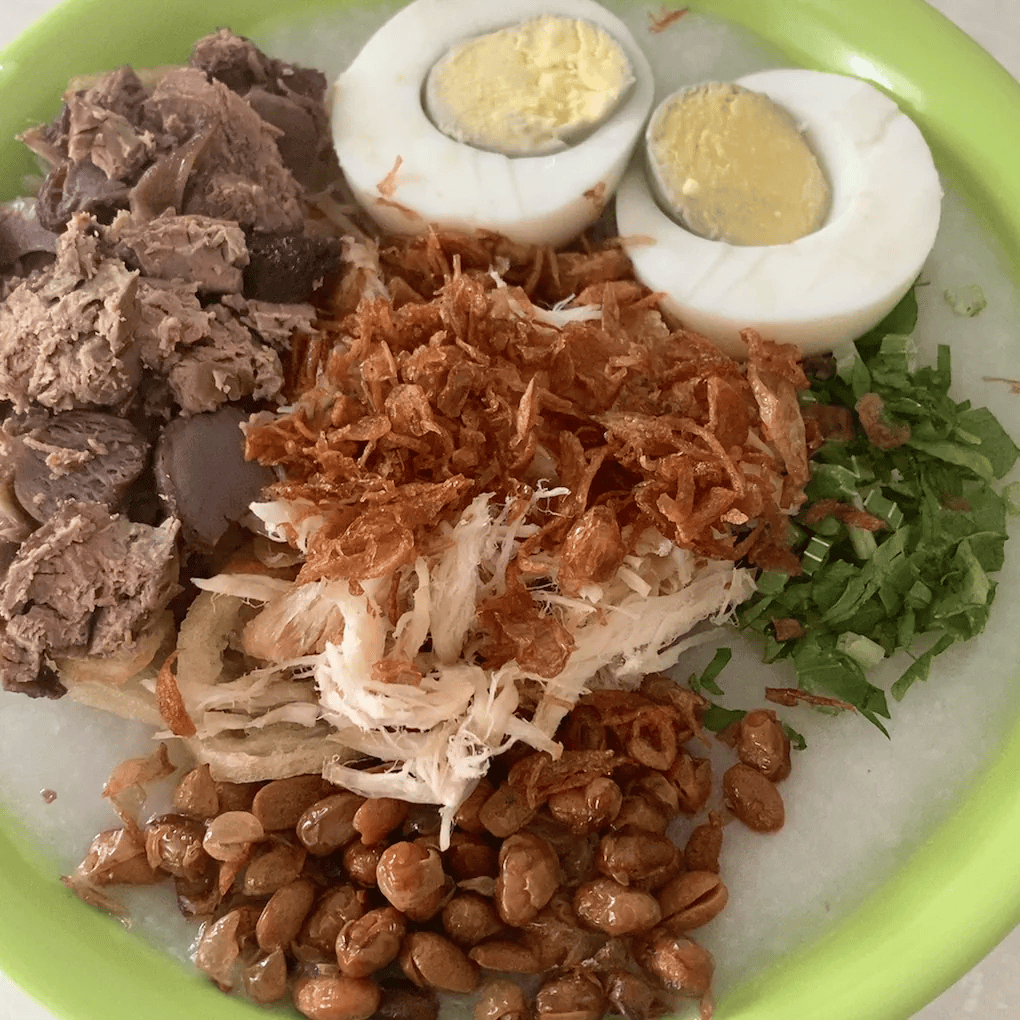
Speaking of food, I need to give a special mention to bubur ayam, or chicken congee. Specifically the style from Bandung, which is similar to Chinese congee if you’ve tried that. In Canada, I look for congee because the familiar taste and texture takes me back to Asia. Bubur ayam has that same familiarity, and I’d say, in the world of congee variations, it’s up there. Arby, who lives in our kost, introduced me to the warung on Jalan Batong Raya, which is on my walking/gojek route to the office. As it’s the only place I know where to find the Bandung style, the owners see me multiple times a week.

Besides bubur ayam, bebek goreng (fried duck leg and rice) has been a treat. It’s covered in this oily chili sauce and the rice is topped with toasted coconut shavings. We eat it with our hands. Eating certain foods with your fingers is, like some words and the congee, another one of those familiar things that Indonesia shares with the Philippines. The bebek goreng warung is adjacent to the bubur ayam shop, on Batong Raya; I also know about it because of Arby. This bebek goreng is a regional variation of the dish- from Madura, a big island in East Java.
Had I been a tourist, I doubt I would have had the relative immobility to learn of a narrow street in South Jakarta, with no sidewalks or cafes, where I’ve had some of my best meals in this country. Did I mention that a full bowl of that bubur ayam costs about $1.5 and a plate of bebek goreng is about $3?
Work has gotten quite busy lately, because two CIPS projects, this CAPI blog, the CAPI reflection and a visa run to Phuket all converged in the last several weeks. The main CIPS project I’ve been helping with during this time has been a review of Indonesia’s fertilizer subsidy program. The government recently changed the subsidy redemption mechanism from physical cards to an app, and has announced that it will implement direct cash transfers soon. My task is to research and write about some international best practices.
I’ve learned something about how different countries try to make their agriculture sectors more prosperous through subsidy programs and freer markets (involving the private sector, import-export, etc.). Countries usually do a bit of both, but freer markets should be the long term priority. Subsidy programs relying entirely on the government to procure and distribute fertilizers have often failed, or are inefficient, because of [all, or one of] corruption, bureaucratic setbacks, and costs. The private sector as a collection of actors is less centralized and is often more effective at managing production and supply than government is. Countries that involve private actors in subsidy programs have seen much better outcomes; also, fostering a better business environment is important for prosperity. It was surprising to me that welfare state New Zealand does not subsidize agriculture at all, which came out of a necessary course correction on government spending and overproduction in the 1980s. I’ve gained some useful policy insights, and have found myself leaning on the two economics courses I took at UVic to understand some concepts and terms. I’m wanting to go deeper into economics, probably a minor at UVic, because of my time here.
It’s a privilege to be interning at CIPS , in a familial work culture of smart and fun people who work hard on issues I care about. Major reasons I applied to intern here were to experience the working life in a Southeast Asian country and to learn about policy that helps developing countries to thrive. I’m definitely learning a lot, from work and from life in this city.
I’ll conclude with some some photos from my visa runs. Next month we take a six hour train to Yogyakarta City for a long weekend and I’ve been pretty excited about that.


